
A trade career can be much more diverse than many imagine. People often don’t picture the multitude of career options people can take after completing their qualification such as, project management, business ownership, estimating, teaching, building design, or running a multi-million-dollar construction company. But that's exactly where a Certificate II in Construction Pathways can lead. Students, parents, and even teachers assume a trade is a single destination rather than a launching pad. In reality, construction is one of the few industries in Queensland where a single entry-level qualification can branch into dozens of careers — technical, managerial, creative, and entrepreneurial. A trade is a career for anyone, whether you want to work with your hands for life, lead a team, run your own business, or eventually move into design or project delivery. This article walks through that full pathway, from a school-based Certificate II through to business ownership and beyond, using carpentry as a worked example.
Starting the Pathway: Certificate II in Construction Pathways
For Queensland students in Years 10 to 12, the Certificate II in Construction Pathways is typically the first formal step into the industry. It's a foundation qualification, meaning it doesn't lock you into a single trade — instead, it gives you broad, practical exposure to construction industry skills, workplace safety (including White Card training which allows for direct entry into labouring or trades assistant roles), and hands-on experience across multiple trade areas. This is usually delivered through a school's VETiS (Vocational Education and Training in Schools) program, often one day a week over one school year, allowing students to complete genuine vocational training alongside their senior schooling. As a Queensland-based RTO (Registered Training Organisation), Inscope Training partners directly with schools across Brisbane and greater Queensland to deliver this training in a way that's flexible, supervised, and credentialed. What makes the Certificate II valuable isn't just the qualification on paper — it's the experience. Students get a genuine feel for the construction industry before committing to an apprenticeship, build practical skills employers look for, and in many cases gain a head start toward a Certificate III apprenticeship. It removes a lot of the guesswork young people face when choosing a career, and it does so at no out of pocket cost to eligible students under current funding arrangements.
Certificate III: Becoming a Qualified Tradesperson
From there, the next step is a Certificate III in a specific trade — carpentry, plumbing, electrical, painting, tiling, plastering, and more. This is the qualification that makes you a licensed, qualified tradesperson, and it must be completed as an apprentice, either school-based or part-time or full-time after graduating.
This stage is where trade apprenticeship training really proves its value. Apprentices earn a wage while they train, graduate without university-style debt, and walk straight into an industry with chronic, sustained demand. Queensland's construction sector has faced a well-documented skills shortage for years, driven by population growth, infrastructure investment, and major projects across Southeast Queensland. Brisbane is facing a significant ramp-up in construction demand in the lead-up to the 2032 Olympic Games, meaning qualified tradespeople aren't just employable now — they're likely to remain in high demand for the next decade.
Once qualified, a tradesperson already has career security most other entry-level qualifications can't match, and there’s plenty of room to progress further.
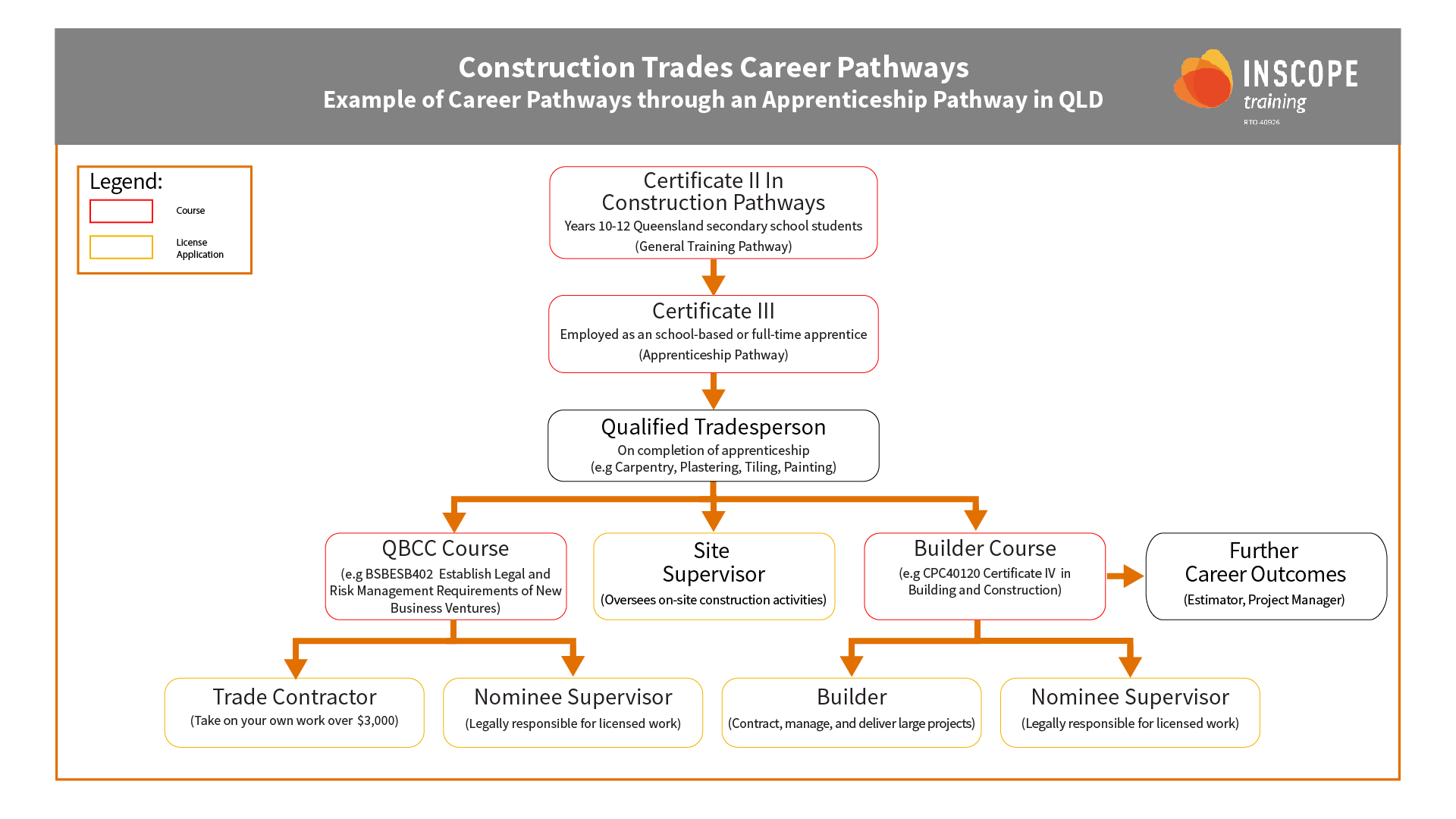
Branch One: Site Supervision and Licensing
A qualified tradesperson can move directly into site supervision, overseeing on-site construction activities and managing day-to-day project delivery — a natural progression that builds on trade experience without requiring a return to full-time study. From here, tradespeople can pursue licensing through the QBCC (Queensland Building and Construction Commission), completing a course such as BSBESB402 to become eligible for licensing pathways. This opens two significant options:
- Trade Contractor — the ability to perform work over $3,000, running your own business under your trade licence.
- Nominee Supervisors are in on-going demand because many licensed construction businesses are legally required to have a qualified nominee overseeing licensed work, and the construction industry continues to experience shortages of experienced supervisory personnel. (Queensland Building and Construction Commission, 2021), (Master Builders Australia, 2024).
This branch suits tradespeople who want more autonomy and income without necessarily stepping away from hands-on work.
Branch Two: Certificate IV, Building, and Business Ownership
The second major branch starts with a Certificate IV in Building and Construction (CPC40120), the gateway to some of the most senior roles in the industry:
- Builder — managing, contracting, and delivering large-scale construction projects.
- Nominee Supervisor — a higher-level licensing pathway tied to builder qualifications.
- Estimator or Scheduler — office-based, project-planning roles at the intersection of construction knowledge and commercial decision-making.
A Certificate IV combined with a builder's licence allows a tradesperson to legitimately run their own building company — managing crews, clients, and entire projects rather than just their own trade work. For many in the industry, this is the long-term goal: starting as an apprentice and ending up owning a Brisbane-based, QBCC-licensed building company.
Beyond the builder pathway, these qualifications and licences also open further outcomes such as project management and senior estimator roles — positions that command strong salaries and sit at the centre of major construction projects, where trade knowledge becomes a competitive advantage.
Beyond the Tools: Diplomas, Design, and Architecture
What surprises a lot of people is just how far a Certificate II or III can stretch outside traditional trade roles. A foundation in construction can support pathways into:
- Diploma of Building and Construction (Management) — for those moving into larger-scale project and construction management roles.
- Diploma of Building Design— particularly relevant for trades like carpentry, where structural and spatial knowledge transfers directly.
- Diploma of Interior Design — a natural progression for tradespeople from painting, tiling, or finishing trades who develop an eye for aesthetics and design on the job.
- Teaching — for those wanting to guide the next generation you can use the skills you learn to teach future apprentices.
This is part of why we say a trade is a career for anyone. A school leaver who loves working with their hands might end up running a building company. Someone with a creative streak might use a painting or tiling background as a springboard into design. Someone who enjoys logistics and planning might move from the tools into estimating or scheduling. The construction industry lets you use your strengths determine where you end up.
Job Security That Actually Holds Up
Queensland's construction industry isn't a short-term boom — it's a structural, long-term demand curve. Population growth across Southeast Queensland, ongoing housing shortages, major infrastructure projects, and the lead-up to Brisbane 2032 all point toward sustained, long-term demand for skilled trades, supervisors, estimators, and builders. Unlike many entry-level career paths, construction offers genuine, durable job security at every level of the pathway — from a first-year apprentice through to a licensed builder running their own business.
A Trade Is a Career for Anyone
Whether you're finishing school, looking for a career change, realising university isn’t for you, a year 10 student weighing up subject choices, a parent trying to understand VETiS options, or a VET coordinator building your school's vocational education offering, the message is the same: a career in construction can be whatever you need it to be. It's a foundation that can lead to a qualified trade, a supervisor's licence, a builder's licence, business ownership, project management, or even a pathway into design and architecture.
At Inscope Training, we deliver the Certificate II in Construction Pathways (CPC20220), as a Queensland RTO partnering with schools across Brisbane and beyond, helping students start strong, stay flexible, and build a career with genuine long-term security — no matter which branch of the pathway they eventually choose.
Interested in construction industry training or a VETiS partnership for your school? Get in touch with Inscope Training to find out how we can help your students start their pathway today.