There's a window opening in the Queensland construction industry — and for anyone considering a carpentry apprenticeship, the timing has rarely been better. Queensland's construction sector is entering one of the most sustained periods of demand in its history. Understanding why, and what it means for someone considering an apprenticeship today can help you make a better decision about your future or support someone who is undergoing that process.
The Numbers Behind the Opportunity
The Construction Skills Queensland (CSQ) Horizon 2032 report paints a clear picture of the opportunities presented in the construction industry: construction labour demand is forecast to grow by 17% between 2027 and 2028, driven by a combination of residential recovery, infrastructure investment, and major project pipelines that stretch well into the next decade.
Within that broader picture, carpenters sit at the top. Carpentry is currently the highest-ranked in-demand occupation across the entire building sector. That alone would make this a compelling time to enter the trade.
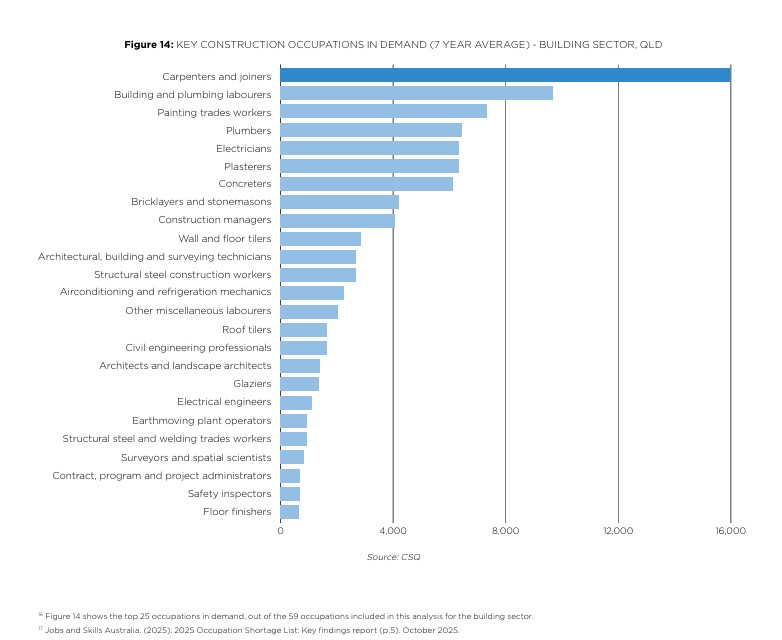
But there's another factor that makes the case even stronger. According to NCVER Carpentry apprenticeship commencements fell by around 13% nationally in the year to December 2024 and continued to fall into 2025. Fewer people are starting. That means the cohort entering the trade today is smaller, the competition for quality positions is lower, and employers are actively looking for committed apprentices.
The Olympic Effect — and Why the Timing Works in Your Favour
The 2032 Brisbane Olympic and Paralympic Games are driving a significant pipeline of non-residential construction work across South-East Queensland. The Horizon 2032 report projects that labour demand from major projects is expected to peak in 2031 — with Brisbane and the Sunshine Coast accounting for the largest share of activity.

A four-year carpentry apprenticeship started today puts a qualified tradesperson into the market right as that peak hits. What makes this particularly resilient is that residential and non-residential construction are expected to peak at different points. This staggered demand means the market for skilled carpenters is unlikely to soften sharply at any single point — instead, sustained demand from one sector supports the other as cycles shift. Add to that a current residential backlog estimated at $18 billion, and the pipeline of work is almost assured.
What Carpentry Actually Involves — and Why It Suits Certain People
Carpenters work across the full arc of a building project. In the early stages, that means framing, structural work, and setting the bones of a structure. As a project progresses, the focus shifts to fit-out, joinery, doors, windows, and finish work — the details that determine how a building looks and functions when it's handed over. No two projects are identical. The work is physical, precise, and varied.
If you're someone who prefers to see a direct result from your effort — something built, standing, measurable — carpentry delivers that in a way that few careers do. It rewards spatial thinking, attention to detail, and a strong work ethic.
Where a Carpentry Career Can Take You
A carpentry apprenticeship is the starting point for a range of professional pathways, many of which move into leadership, business, and management roles over time. Some of the directions our graduates can pursue include:
- Trade Contractor or Builder — Running your own business, taking on contracts, employing others
- Site Supervisor or Nominee Supervisor — Overseeing project delivery and coordinating trades on-site
- Construction Manager or Estimator — Moving into project planning, costing, and bid management
- Construction Scheduler — Managing timelines and resource allocation across large projects
- Operations Manager — Senior leadership across a construction business or division
- Trainer and Assessor — Delivering vocational education and training to the next generation of carpenters
Career progression beyond trade roles often involves further study, with many qualified carpenters choosing to complete either or both of two key qualifications: BSBESB402 – Establish Legal and Risk Management Requirements of New Business Ventures and CPC40120 – Certificate IV in Building and Construction. The qualification required depends on the QBCC licence being sought and the type of building work intended. For a career as a Trainer and Assessor, you'll require onsite experience and a further qualification in TAE40122 Certificate IV in Training and Assessment. This flexibility means a carpentry apprenticeship started today can lead to very different—and increasingly diverse—career outcomes over the next twenty years.
Taking the Next Step
If you're considering a carpentry apprenticeship — or supporting someone who is — we'd encourage you not to wait. The apprentices who start now will graduate into one of the most exciting times in the industry with a peak demand for skilled workers.
If your interested contact us on 1300 579 808 or email